Transposing a song means moving every note by the same fixed amount, up or down, while keeping the structure exactly the same. That's the whole thing. The rhythm stays, the feel stays, the relationships between notes stay — you're just shifting the whole song higher or lower.
It's still the same song. A tune in C played in G is the same tune, just in a different register. The unit you count in is the semitone, also called a half step. There are twelve of them in Western music — one guitar fret, one piano key each. Get comfortable with that and the rest falls into place.
TABLE OF CONTENTS
What transposing actually does (and doesn't do)
Transposition changes the absolute pitch of a song. That's it. The relationships between the notes and chords don't move — they all shift together, so the distances between them stay identical.
The rhythm doesn't change. The intervals don't change. The character of the melody doesn't change. A song in C sounds essentially the same in G, just higher or lower.
Everything gets measured in semitones — the space between two adjacent piano keys, or two adjacent guitar frets. Twelve semitones and you're back where you started, an octave up or down. Once you can count in half steps, transposing is mostly arithmetic.
The interval method: move every note the same distance
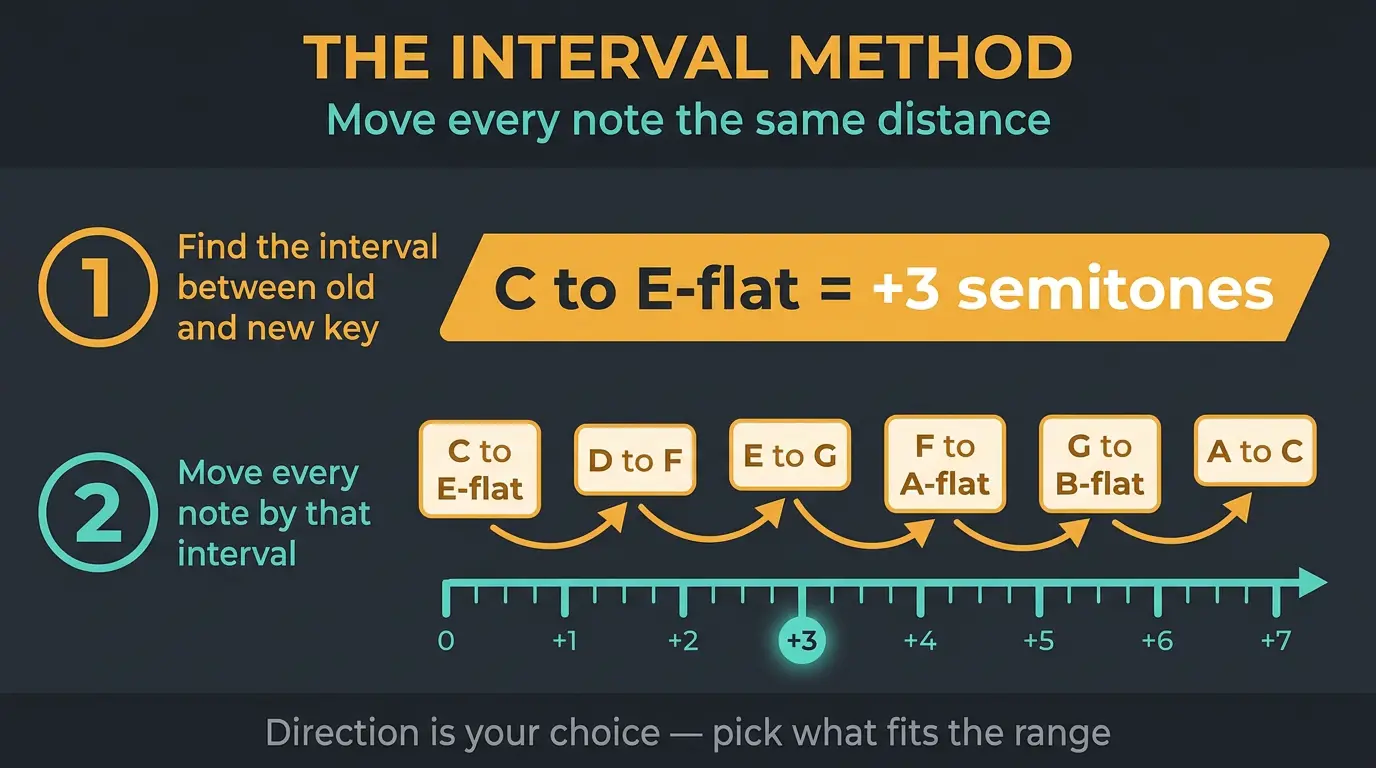
This is the reliable, note-by-note method for melodies. Two steps.
First, find the interval between the old key and the new key. Second, move every note by that interval. That's the whole method.
To keep the math clean, count in semitones. A perfect fifth is seven semitones, so that's +7 going up or -7 going down. Say you're moving from C to E-flat, which is three semitones up. Every note goes up three: C→E-flat, D→F, E→G, F→A-flat, G→B-flat, and so on down the line.
One practical note on direction. Sometimes moving up one step gets you to a note faster than moving down five steps to the same note name. There isn't a right or wrong direction here — pick whichever sits best in the range you want and trust your ears. If you want to go deeper on how these note relationships work, our guide to music scale degrees is a good next stop.
The numbers method: the fast way to move chords
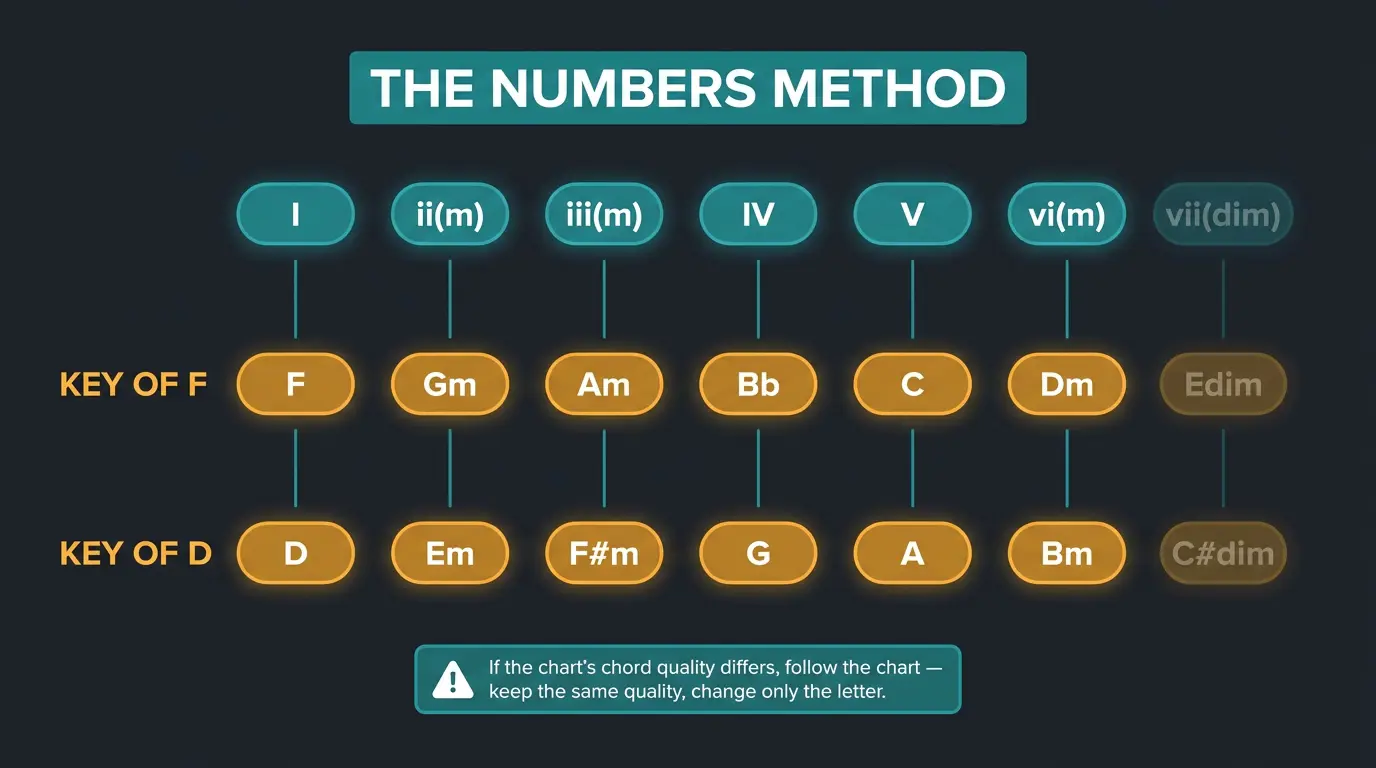
For chord-based music — pop, hymns, jazz — this is the fast way. Label each chord by its scale degree, then respell those numbers in the new key. The chord symbols do all the work, so you never touch individual notes.
In any major key, the diatonic chords follow the same pattern: I, ii(m), iii(m), IV, V, vi(m). Plug in the letters and you're done.
- Key of F: F – Gm – Am – B-flat – C – Dm
- Key of D: D – Em – F#m – G – A – Bm
One honest catch. If the original chart says a chord is major or minor and that doesn't match the diatonic default, follow the chart. The original is your guide — just change the letter to fit the new key and keep the quality the same. If Roman numerals are new to you, the chords in the key of C post walks through where they come from.
Capo shortcuts for guitar players
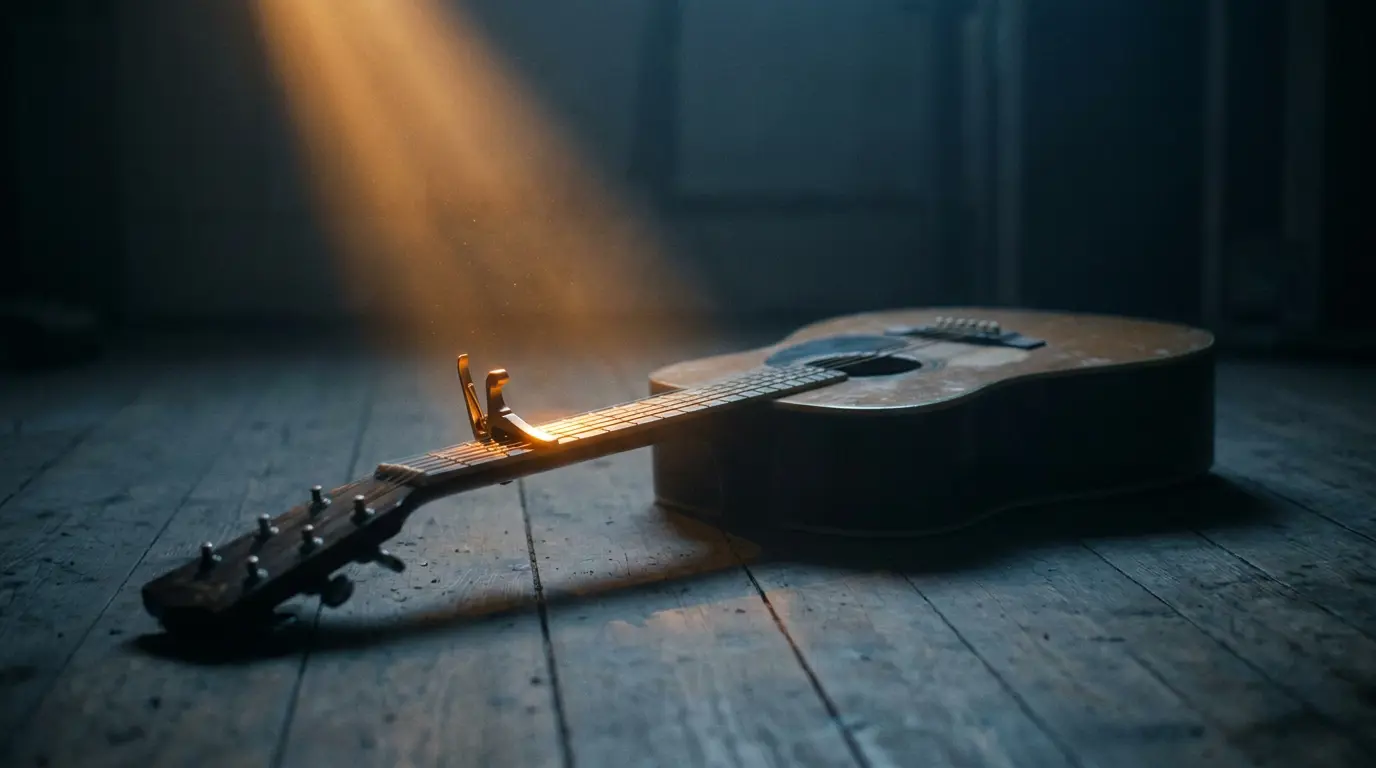
A capo is a clamp that presses every string down at one fret. That's the whole mechanism. It turns that fret into your new nut, so the shapes you play sound higher than they look.
The core rule: one fret up equals one semitone up. And the formula for figuring out placement is simple — chord shape key equals sounding key minus the capo fret.
- Need to play in A? Capo fret 2, play G shapes.
- Need to play in E-flat? Capo fret 1, play D shapes.
- Matching a pianist in E-flat? Capo fret 3, play C shapes.
Why bother? Songs in B-flat and E-flat are full of barre chords, and nobody loves those unless they have to play them. A capo lets you use easy open shapes instead, and you get that open-string ring you can't fake with a barre.
A couple of honest limits. A capo only raises pitch — it can't lower it — and it only works on fretted instruments. Above the 7th or 8th fret it starts sounding thin and choked. At that point, skip the capo and just learn the real voicings in that key.
Transposing chords vs. melody
The principle behind both is the same: everything moves by the same interval. Chords are usually the easier job because you can lean on the numbers. Melody is note-by-note, so it takes a little more care.
For a written melody, here's the three-step sequence:
- Change the key signature to the new key.
- Move every note by the interval.
- Fix the accidentals so they fit the new key.
Here's the point people forget most: accidentals move too, by the same interval as everything else. If you see an A-flat as an accidental in the original, it shifts by the exact same distance as the rest of the notes. Miss that and one wrong note sneaks through the whole chart. For more on how key signatures relate to each other, the circle of fifths is worth a look.
Finding a key that fits your voice
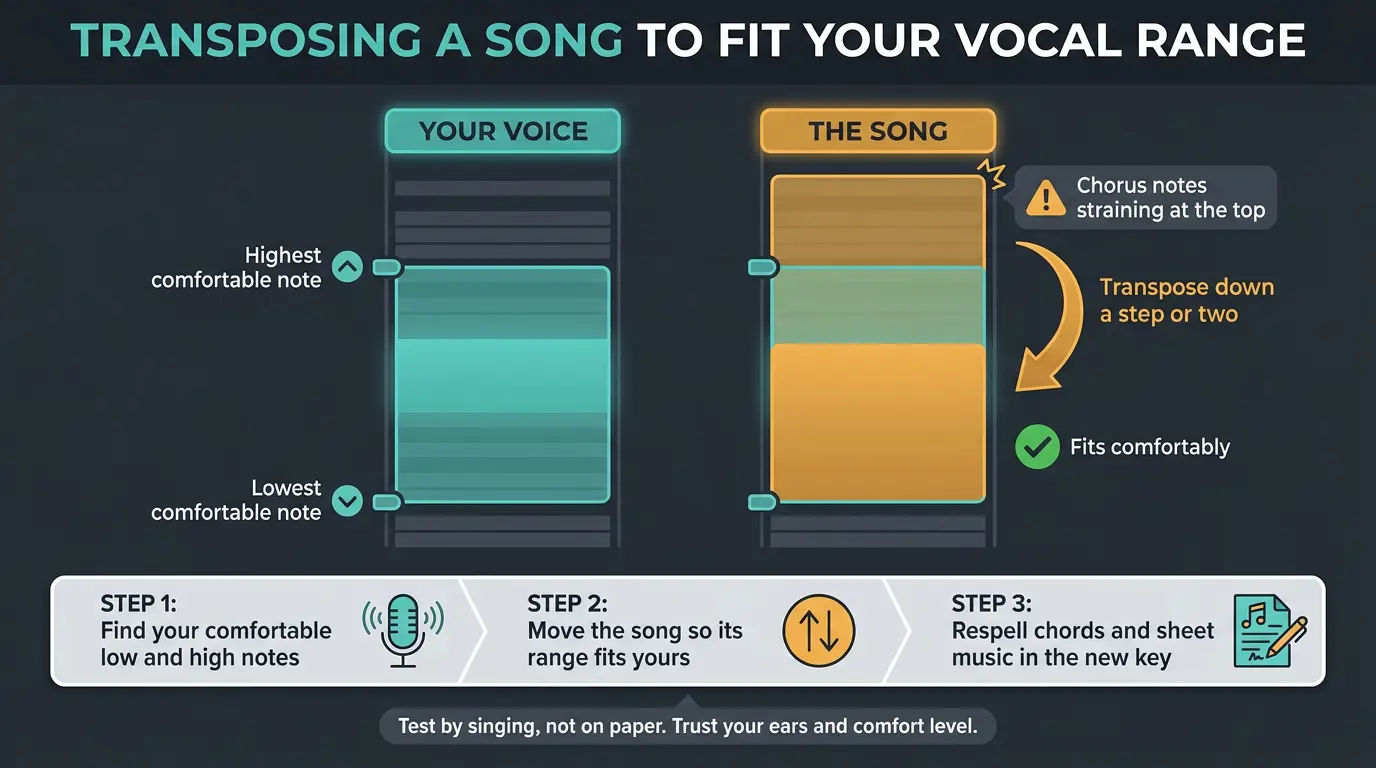
Here's a common misconception worth clearing up. Singers don't have "a key." They have a range — the lowest to the highest note they can sing comfortably. Every song has a range too, from its lowest note to its highest.
So the job is lining up the song's range with yours. Three steps:
- Find the lowest and highest notes you can sing comfortably.
- Decide how far to move the song so its range lands inside yours.
- Get the chords and sheet music respelled in that new key.
Make sure you test it by actually singing, not by guessing on paper. You don't need perfect pitch or a music degree for any of this — you just need to move the song and try it. If the chorus notes are straining you at the top, drop it a step or two and sing it again.
Transposing at a glance
- Everything moves by the same interval — chords, melody, and accidentals all shift together.
- Count in semitones. There are twelve half steps in the octave, one per guitar fret or piano key.
- Use the numbers method for chords and the interval method for melody.
- A capo only raises pitch and starts sounding thin above the 7th or 8th fret — past that, learn the real voicings.
Frequently Asked Questions (FAQs)
What does it mean to transpose a song?
Transposing a song means moving every note by the same fixed interval, up or down, while keeping the structure the same. The rhythm, the intervals between notes, and the character all stay put. Only the pitch changes, so it's the same song sitting higher or lower.
How do I transpose a song into a different key?
Find the interval between the old key and the new one, then move everything by that same amount. For chords, label them by number and respell those numbers in the new key. For melody, shift every note — including accidentals — by the interval and fix the key signature to match.
How do I know how many semitones to move?
Count the half steps between your starting key and your target key — one semitone per guitar fret or piano key. There are twelve total in an octave. If you're fitting a song to your voice, move it however many semitones it takes for the song's range to land comfortably in yours.
Can I transpose without knowing music theory?
Yes. The numbers method lets you swap chords by scale degree without reading a single note, and most software will transpose a chart for you. You don't need perfect pitch or a degree. Just move everything by the same amount and test it with your ears.
Does a capo actually transpose a song, and why can't it go the other way?
Yes, a capo transposes by raising every string's pitch — one fret equals one semitone up. It can't lower pitch because it physically shortens the strings rather than lengthening them, and there's no way to clamp below the nut. That's why a capo only ever moves a song higher.
Final Thoughts
Transposing isn't magic and it isn't for people with perfect pitch. It's counting and moving. Once you see that everything shifts by the same amount, the whole thing stops feeling intimidating and starts feeling like arithmetic you can do at the kitchen table.
Pick whichever method fits the job — numbers for chords, interval for melody, a capo when you just want easy shapes. Then sing it or play it and trust what your ears tell you. Less is more, and the same song in the right key almost always sounds better.
Some of the links within this article are affiliate links. These links are from various companies such as Amazon. This means if you click on any of these links and purchase the item or service, I will receive an affiliate commission. This is at no cost to you and the money gets invested back into Audio Sorcerer LLC.