Every musical note has a frequency, and that frequency is just a number in hertz. A4 vibrates at 440 cycles per second. Knowing these numbers isn't trivia — it helps you EQ smarter, tune samples, and understand what you're actually looking at on a spectrum analyzer.
Quick clarification before we go further: frequency is cycles per second, not the speed of the wave. Those are two different things, and mixing them up leads to some real confusion. We'll sort that out first.
Then we'll get into the full chart from C0 to B8, the formula that generates every value, how it all connects to MIDI, and the honest truth about 440 Hz versus 432 Hz. Let's get into it.
TABLE OF CONTENTS
What frequency actually is
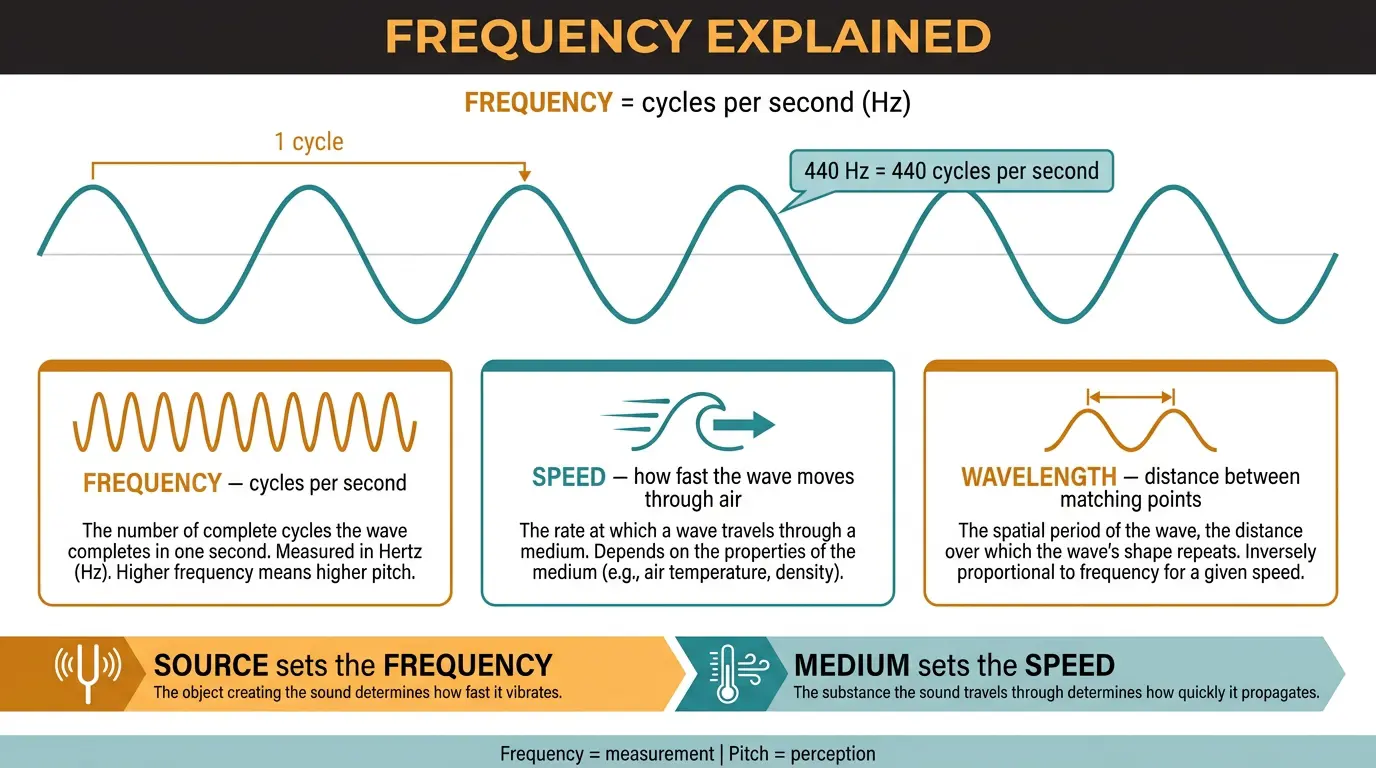
Frequency is the number of cycles a wave completes in one second. It's measured in hertz, where one hertz equals one cycle per second. That's it. A note at 440 Hz cycles 440 times every second.
Here's where people trip up. Frequency, speed, and wavelength are three separate properties, and they get jumbled together all the time.
- Frequency — how many full cycles happen each second.
- Speed — how fast the pressure wave moves through the air.
- Wavelength — the distance between two matching points on the wave.
The key thing to hold onto: the source sets the frequency, and the medium sets the speed. A tuning fork doesn't care if the air is warm or cold. It makes the same cycles per second either way. What changes with the air temperature is how fast that wave travels, which shifts the wavelength — not the frequency.
One more line worth drawing. Frequency is a measurement. Pitch is a perception. They're closely related, but they're not the same thing, which is why we cover the difference in more depth in our piece on what pitch is in music.
The frequency notes chart (C0 to B8)
Here's the full run from C0 at 16.35 Hz all the way up to B8 at 7902.13 Hz. These are 12-tone equal temperament values with A4 pinned at 440 Hz — the standard nearly everyone works in.
Notice the pattern with octaves. Every time you go up an octave, the frequency doubles. A3 is 220 Hz, A4 is 440 Hz, A5 is 880 Hz. Same note name, double the number, every single time. That doubling holds for every note on the chart.
I also added a wavelength column, because for anyone working in audio it's genuinely useful to know that low notes have long waves and high notes have short ones. That matters for room acoustics and low-end problems. Use the chart as a reference — no need to memorize it.
| Note | Frequency (Hz) | Wavelength (approx) | MIDI Note |
|---|---|---|---|
| C0 | 16.35 | 21.0 m | 12 |
| A0 | 27.50 | 12.5 m | 21 |
| C1 | 32.70 | 10.5 m | 24 |
| A1 | 55.00 | 6.24 m | 33 |
| C2 | 65.41 | 5.24 m | 36 |
| E2 | 82.41 | 4.16 m | 40 |
| A2 | 110.00 | 3.12 m | 45 |
| C3 | 130.81 | 2.62 m | 48 |
| A3 | 220.00 | 1.56 m | 57 |
| C4 (middle C) | 261.63 | 1.31 m | 60 |
| A4 | 440.00 | 0.78 m | 69 |
| C5 | 523.25 | 0.66 m | 72 |
| A5 | 880.00 | 0.39 m | 81 |
| C6 | 1046.50 | 0.33 m | 84 |
| A6 | 1760.00 | 0.20 m | 93 |
| C7 | 2093.00 | 0.16 m | 96 |
| A7 | 3520.00 | 0.10 m | 105 |
| C8 | 4186.01 | 8.2 cm | 108 |
| A8 | 7040.00 | 4.9 cm | 117 |
| B8 | 7902.13 | 4.3 cm | 119 |
The math behind the numbers
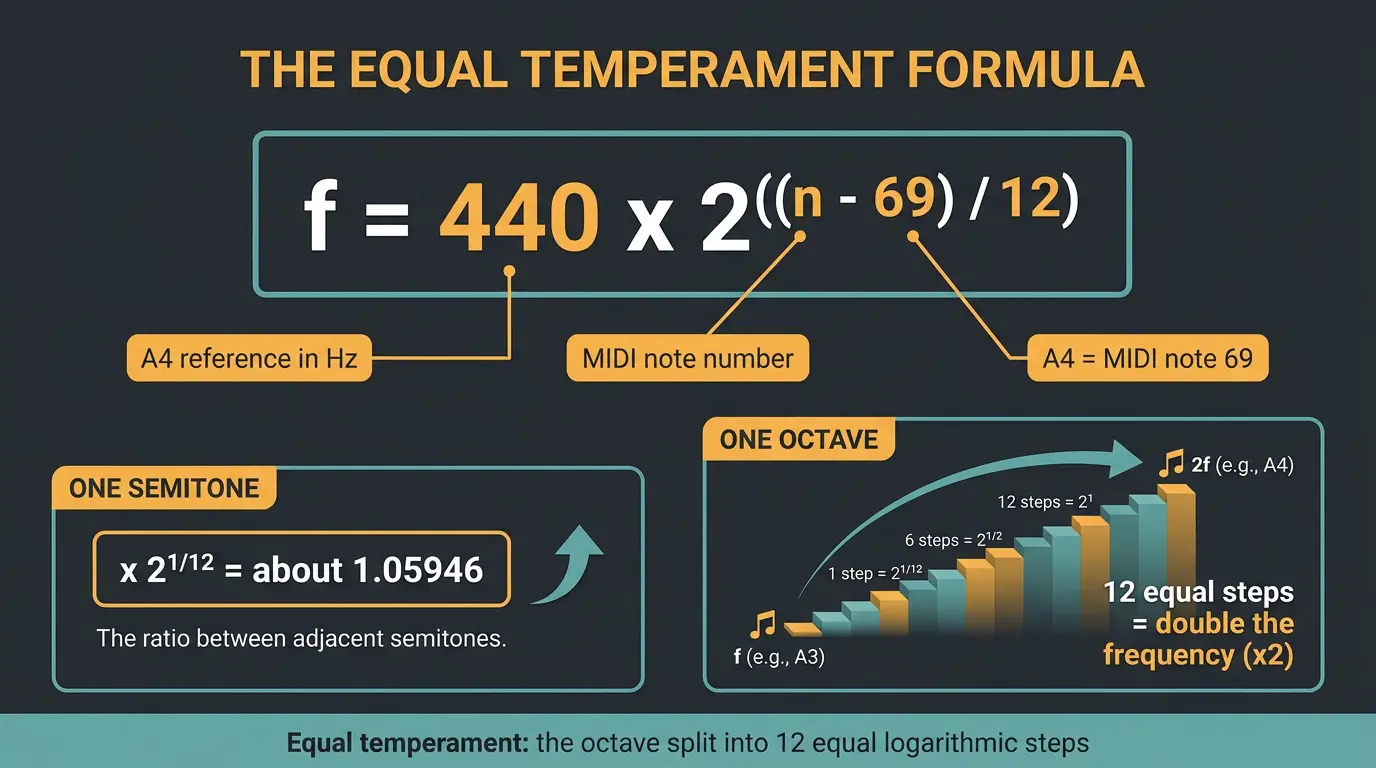
You don't have to look these numbers up. There's one formula that generates every value on the chart:
f = 440 × 2^((n−69)/12)
Let's break down each piece. The 440 is your A4 reference in hertz. The n is the MIDI note number of whatever note you want, and A4 sits at MIDI note 69 — that's why 69 shows up in the formula. Plug in a note number, run the math, and out comes the frequency.
The heart of it is that each semitone multiplies the frequency by 2^(1/12), which works out to about 1.05946. Move up one semitone, multiply by 1.05946. Do that twelve times in a row and you've doubled the frequency — which is exactly one octave.
That's what equal temperament means. The octave gets split into 12 equal steps on a logarithmic scale, so every semitone is the same size as its neighbors. The payoff is that you can play in any key and it all stays equally consonant. If you want to go deeper on how those steps build scales, our guide to music scale degrees picks up right there.
How this connects to MIDI
If you work in a DAW, this chart is already living in your session whether you think about it or not. MIDI note 69 is A4 at 440 Hz. MIDI note 60 is middle C, which is C4 at about 261.63 Hz. And every 12 MIDI steps is exactly one octave.
Why care? Because it lets you connect a note you're playing to a spot on the frequency spectrum. Say you've got a bass part sitting around E1 and the low end feels muddy — now you know roughly where that fundamental lives when you reach for the EQ. Same idea when you're tuning samples or lining up a resonance to a musical note. The note and the number are the same thing.
Why 440 Hz is the standard (and where it came from)
440 Hz feels like a law of nature, but it isn't. It's a convention we agreed on, and that agreement came surprisingly late.
Before 1939, concert pitch was all over the map. Through the 1700s and 1800s, the A above middle C ranged anywhere from about 400 Hz to over 450 Hz depending on the city and the era. France tried to bring order in 1859 by setting A=435 Hz as its official standard, the "diapason normal."
Then in 1939, delegates from several countries recommended A=440 Hz, and it was published as a British standard that same year. The International Organization for Standardization made it official in 1955 as ISO 16, reaffirmed it in 1975, and it's still in effect today. If you want the deeper history, the A440 pitch standard writeup lays it all out. The takeaway: 440 is a chosen reference, not a universal constant.
Alternative tunings you'll run into
Since 440 is a convention, it's no surprise that plenty of musicians use something else. These aren't mistakes — they're legitimate choices you'll actually bump into.
A lot of orchestras tune slightly sharp, somewhere in the 441 to 443 Hz range, for a brighter, more brilliant sound. It's subtle, but the players hear it and lean into it.
Baroque music is the bigger departure. Historically it used A4 around 415 Hz, which lands roughly a semitone below 440. That's actually why 415 is such a convenient number — it's close enough to "440 minus one semitone" that ensembles playing period repertoire can use it as a clean reference point. None of these are wrong. They're just different starting pitches.
The 432 Hz question, honestly
You've probably seen the 432 Hz claims — that it's the "natural" frequency, that it resonates with the universe, that 440 was imposed on us for shady reasons. Let's keep this straight.
432 Hz is a choice of reference pitch, and nothing more. There's no accredited research showing it has any acoustic, biological, or therapeutic edge over 440 or anything else. When researchers actually ran listener-preference studies, participants tended to favor the standard 440 Hz recordings.
The "ancient 432 Hz" stories and the conspiracy angles have been documented as misinformation by fact-checkers and acoustics experts. There's no real evidence any historical tuning was pinned to 432. With that being said — if you like how 432 sounds, use it. Preference is completely valid. Just don't reach for it because someone told you the science backs it up, because it doesn't.
Quick reference
- Frequency is cycles per second, not the speed of the wave — the source sets frequency, the medium sets speed.
- A4 = 440 Hz is the international standard, formalized as ISO 16 in 1955.
- Going up one octave doubles the frequency: A3 = 220, A4 = 440, A5 = 880.
- The semitone ratio is 2^(1/12), about 1.05946 — do it twelve times and you've doubled the frequency.
Frequently Asked Questions (FAQs)
What is the frequency of A4?
A4 is 440 Hz in standard tuning, meaning the A above middle C vibrates 440 times per second. This is the international reference pitch, formally set as ISO 16. Some orchestras nudge it up to 441–443 Hz for a brighter sound, but 440 is the default nearly everyone works in.
Is frequency the same as pitch?
No. Frequency is a physical measurement — the number of cycles per second in hertz. Pitch is how your ear and brain perceive that frequency. They're closely tied, but they're not identical, and factors like loudness and timbre can subtly shift perceived pitch even when the frequency stays put.
How do I calculate the frequency of any note?
Use the formula f = 440 × 2^((n−69)/12), where n is the MIDI note number and 440 is your A4 reference. Each semitone multiplies the frequency by about 1.05946. Plug in the note number and you get the exact frequency for 12-tone equal temperament.
Is 432 Hz better than 440 Hz?
No, there's no credible research showing 432 Hz is acoustically, biologically, or therapeutically superior to 440 Hz. Listener-preference studies actually favored 440. 432 is a valid choice if you prefer how it sounds, but the claims about it being a special "natural" frequency are unfounded.
Why does an octave double the frequency?
An octave doubles the frequency because that 2:1 ratio is the simplest harmonic relationship, and our ears hear it as the "same" note higher up. A4 is 440 Hz, A5 is 880 Hz, A3 is 220 Hz. In equal temperament, twelve semitones stacked up multiply out to exactly double.
Final Thoughts
The chart is a reference, not something to memorize. What's worth keeping in your head is the shape of it: octaves double, semitones multiply by about 1.05946, and A4 sits at 440 Hz because we all agreed it should. Everything else follows from there.
Once those numbers stop feeling like magic and start feeling like a tool, your EQ moves and tuning decisions get a lot more deliberate. That's the whole point — less guessing, more knowing.
Some of the links within this article are affiliate links. These links are from various companies such as Amazon. This means if you click on any of these links and purchase the item or service, I will receive an affiliate commission. This is at no cost to you and the money gets invested back into Audio Sorcerer LLC.