Songwriter pay has a huge range. Some writers make almost nothing. Others clear six figures. Same job title, wildly different checks.
Most of the confusion isn't about talent or luck. It's about the fact that a songwriter gets paid through several separate income streams, and each one works differently. Miss one and you're leaving money behind without ever knowing it.
So let's break down every stream in plain language, look at what the numbers actually say in 2026, and talk about the money most independent artists never collect.
TABLE OF CONTENTS
Who counts as a songwriter
"Songwriter" is a catch-all. It covers the composer who wrote the melody, the lyricist who wrote the words, the topliner who came up with the hook, and the beatmaker who built the track. If you contributed to the composition, you're a songwriter.
Here's the part that decides your pay: it's not about the title, it's about what rights you hold in the song and how you actually collect on them. Two people with the same credit can earn very different amounts depending on how they're set up. Keep that in mind as we go.
The two royalties that trip everyone up
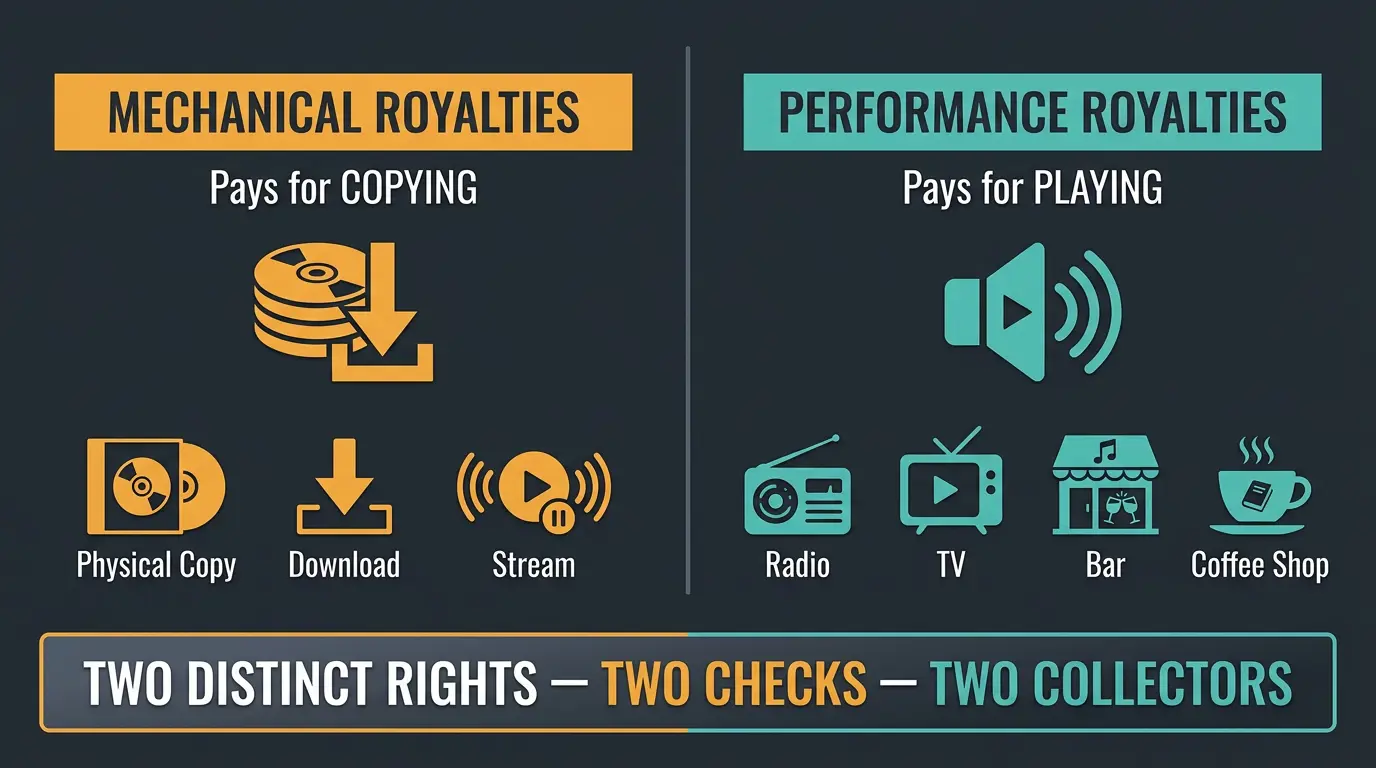
Almost all the confusion around songwriter money comes down to one distinction. There are two main royalties, they're separate, and they pay you through different pipes.
Mechanical royalties pay for copying. Every time your song gets reproduced — a physical copy, a download, a stream — a mechanical royalty is owed on the composition.
Performance royalties pay for playing. Every time your song gets played in public — radio, TV, a stream, a bar, a coffee shop — a performance royalty is owed.
Two distinct rights. Two distinct checks. Two different organizations collecting them. Once that clicks, the rest of this makes a lot more sense.
Mechanical royalties: what copying pays
For physical copies and permanent downloads, the U.S. statutory mechanical rate is 13.1 cents per track as of January 1, 2026 (or 2.52 cents per minute for songs over five minutes, whichever is higher). That's set by the Copyright Royalty Board, not by the labels.
That number matters more than it looks. The rate sat frozen at 9.1 cents for 15 years, from 2006 through 2022, while inflation quietly ate away at its value. The current 13.1 cents is a 44% jump over that old frozen rate — the highest statutory mechanical rate in U.S. history.
Streaming has its own mechanical rate. In 2026, songwriters and publishers get 15.3% of a streaming service's U.S. revenue, rising to 15.35% in 2027. In the U.S., those streaming mechanicals are collected by the Mechanical Licensing Collective, or MLC. Hold onto that name — it comes back later. For a deeper dive on the mechanical side, this guide from Royalty Exchange lays it out well.
Performance royalties and the PROs
Performance royalties get collected by Performance Rights Organizations — ASCAP, BMI, and SESAC. They cover public performance just about everywhere: radio, TV, streaming services, live venues, restaurants, retail stores, anywhere your music plays outside a private setting. There's more detail on how that works in our breakdown of what a public performance license actually is.
The scale here is real. ASCAP distributed $1.759 billion in royalties in 2025, its highest year ever. That's money flowing to songwriters for public plays.
If you're just starting out, one practical note: BMI doesn't charge songwriters to join, while ASCAP has a one-time application fee. Neither is objectively better, but free is a nice on-ramp for emerging writers. Make sure you're registered with one of them — if you're not, nobody is collecting your performance royalties.
What streaming actually pays a songwriter
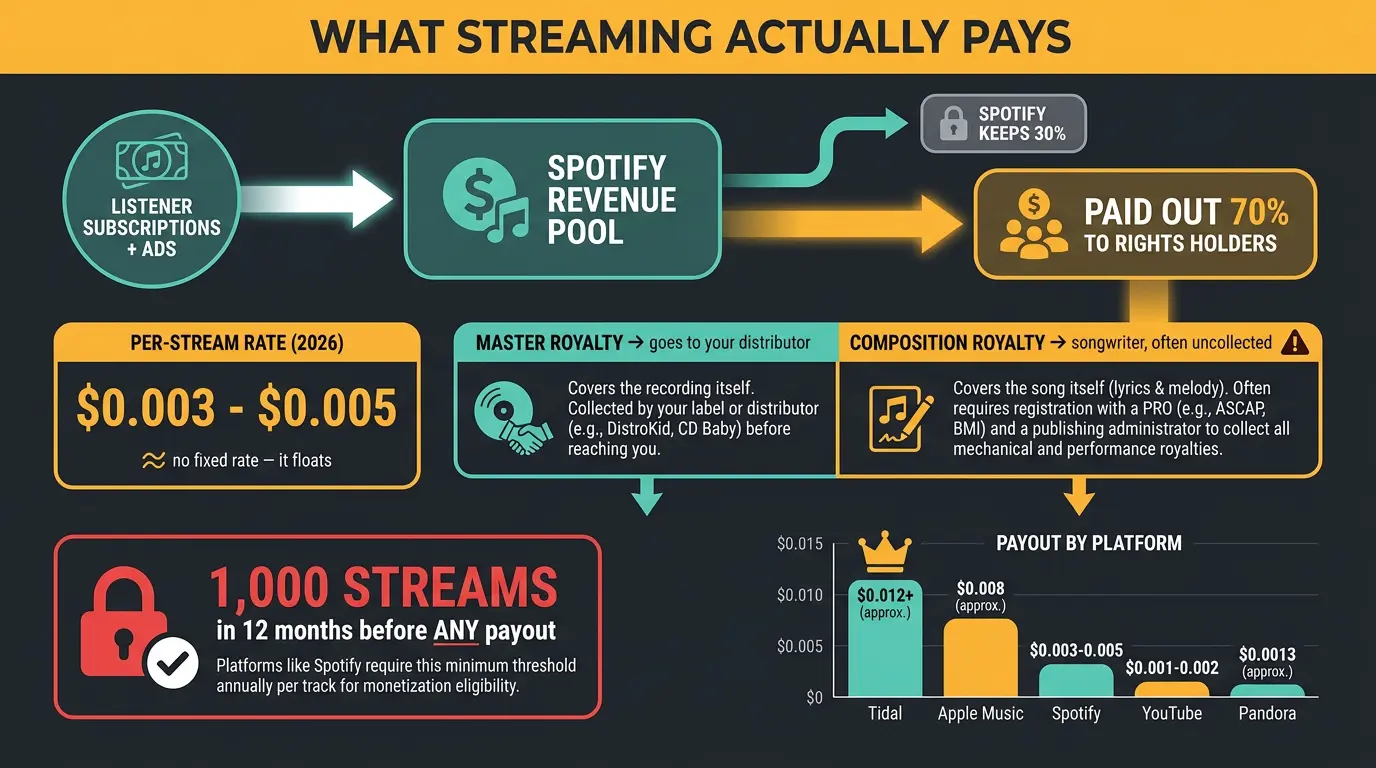
Everybody wants the per-stream number. In 2026, Spotify pays roughly $0.003 to $0.005 per stream. But here's the thing — there is no fixed rate. Spotify pools its subscription and ad revenue, keeps 30%, and pays out 70% to rights holders based on each artist's share of total streams. So your per-stream payout floats.
Now the part almost nobody explains. That per-stream figure is only the master royalty, and it goes to your distributor. Your songwriter composition royalties are separate — and most independent artists never collect them at all. That's the gap that quietly costs people real money.
One more wrinkle. Since April 2024, a track has to clear 1,000 streams in a rolling 12-month window before it earns anything on Spotify. Under that line, you earn nothing. Zero.
Payouts also swing by platform. Tidal and Apple Music pay more per stream than Spotify, while YouTube and Pandora pay less. So the same song earns a different amount depending on where it's played.
The money most artists leave on the table
- Register with a PRO (ASCAP, BMI, or SESAC) so your performance royalties actually get collected. Without this, every radio play, sync broadcast, and public stream earns you nothing.
- Register with the MLC to collect your U.S. streaming mechanical royalties. It's free, and it's the piece most independent artists skip — which means they leave composition money uncollected.
- Consider a publishing administrator like Songtrust to chase down royalties overseas. International collection is messy, and an admin catches money you'd never track down on your own.
Sync licensing: the underrated income stream
Sync is your song landing in film, TV, or a commercial. The split is almost always 50/50 — the studio or ad agency cuts one check to the publisher and one to the label. That's the upfront fee, and it's the part people focus on.
But a placement actually creates two income streams. There's the one-time sync fee, and then there are performance royalties that flow every single time that show or ad airs, collected by your PRO. That's why registration matters so much.
The long tail is where it gets interesting. A network show can run in syndication for a decade, and over that stretch the performance royalties can end up paying more than the original sync fee did. If you want to go deeper, we've got full guides on how sync licensing works and on what sync agents do.
So what does a songwriter actually earn?
Here's the honest answer: it's a wide spread, not a single number. Anyone who gives you one clean figure is either guessing or selling something.
The salary averages in the table below range from the mid-$30k area to nearly $90k, depending on the source. But there's a catch worth flagging. Those aggregator numbers reflect salaried, employed songwriter roles. They don't capture royalty income at all — which can be far lower or far higher.
On the low end, plenty of independents earn close to nothing from streaming, partly because of that 1,000-stream threshold. On the high end, established writers in markets like New York clear six figures. Same job, opposite ends of the map.
| Source | Average | Notes |
|---|---|---|
| ZipRecruiter (Professional Songwriter) | ~$44,338/yr | Most fall between $36.5k and $48k; top earners near $57.5k |
| ZipRecruiter (Singer-Songwriter) | ~$34,307/yr | Lower average; reflects the independent artist reality |
| SalaryExpert | ~$58,653/yr | Entry level ~$43k, senior (8+ yrs) ~$66k |
| Comparably | ~$73,428/yr | Higher mid-range estimate |
| Glassdoor | ~$89,483/yr | Skews high; NY average tops $100k |
AI, registration, and what changed recently
One recent shift worth knowing. As of October 2025, ASCAP, BMI, and SOCAN accept registrations for works that combine AI-generated content with human authorship. So if you used AI tools as part of your process but you actually wrote the song, you can register it.
The line is human involvement. Compositions created entirely by AI, with no human authorship, still can't be registered. If AI is part of your workflow, it's worth reading up on whether you can copyright AI-generated music before you release anything.
Frequently Asked Questions (FAQs)
Do songwriters get paid per stream?
Not with a fixed per-stream rate. Streaming services pool their revenue and pay out a share based on your proportion of total streams, so the effective rate floats — roughly $0.003 to $0.005 per stream on Spotify in 2026. And that figure is only the master royalty; your songwriter composition royalties are collected separately.
What's the difference between mechanical and performance royalties?
Mechanical royalties pay for copying your song — physical copies, downloads, and streams. Performance royalties pay for playing it publicly — radio, TV, streaming, venues, and stores. They're two separate rights collected by two different organizations, and you need to be set up to collect both.
How do I collect all my songwriter royalties?
Register with a PRO for performance royalties and with the MLC for U.S. streaming mechanicals. For international collection, a publishing administrator like Songtrust helps. Most independent artists only handle one of these, which is exactly why so much songwriter money goes uncollected every year.
Do I need to join both a PRO and the MLC?
Yes, if you want all your money. A PRO (ASCAP, BMI, or SESAC) collects your performance royalties, while the MLC collects your U.S. streaming mechanicals. They cover different rights, so joining one doesn't cover the other. MLC registration is free, so there's no reason to skip it.
Can you make a living as a songwriter?
Yes, but income varies enormously. Reported averages range from the mid-$30k area to nearly $90k, and royalty income can push established writers into six figures or leave newer ones near zero. Making a living usually means collecting from every stream — performance, mechanical, streaming, and sync — not just one.
Final Thoughts
Songwriter money isn't one number, it's a stack of separate streams, and the writers who do well are usually the ones who collect from all of them. The talent gets you the song. The paperwork gets you paid.
So make sure you're registered with a PRO and the MLC before you chase your next release. It's the least glamorous part of the job — but it's the part that quietly decides how much of your work actually turns into a check.
Some of the links within this article are affiliate links. These links are from various companies such as Amazon. This means if you click on any of these links and purchase the item or service, I will receive an affiliate commission. This is at no cost to you and the money gets invested back into Audio Sorcerer LLC.