Tuning a guitar trips up almost every beginner, and it shouldn't. Once you know the six notes and pick a tool, you can be in tune in under a minute. That's the whole thing.
There are four ways to get there: a clip-on or pedal tuner, a smartphone app, a free browser tuner, or your own ears. We'll walk through all of them, plus how pitch actually works and what that A440 number on your tuner means. Let's give it a listen.
TABLE OF CONTENTS
Standard tuning: E, A, D, G, B, E
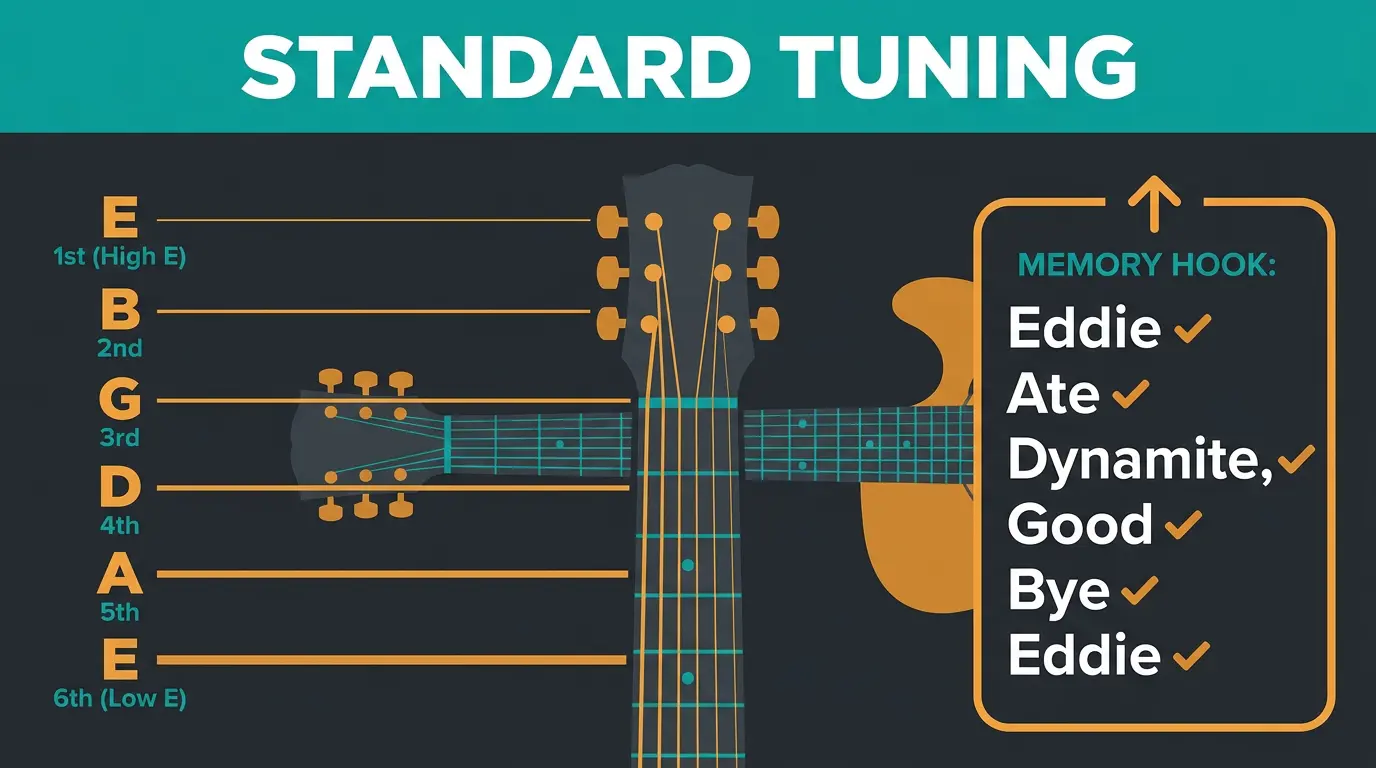
Standard tuning is E–A–D–G–B–E, from the thickest string to the thinnest. The strings are numbered the other way around, which trips people up. The thin high E is the 1st string, and the thick low E is the 6th.
So counting from the thickest: 6th is low E, 5th is A, 4th is D, 3rd is G, 2nd is B, 1st is high E. Same layout whether you're on an acoustic or an electric.
If you want a memory hook, plenty of players use something like "Eddie Ate Dynamite, Good Bye Eddie" from low to high. Corny? Absolutely. But it sticks, and that's the point.
How pitch actually works
Every string runs from the bridge up to a tuning peg. Turning that peg tightens or loosens the string, and that's what moves the note. Tighten it and the pitch goes up (sharp). Loosen it and the pitch goes down (flat).
Here's one habit worth building early: always tune up to the note, not down to it. If you overshoot and go sharp, drop below the note and come back up. Coming up to pitch seats the string more evenly and holds better, so you're not retuning two minutes later.
Method 1: Clip-on and pedal tuners

For most players, a clip-on tuner is the easiest route, and it's what I'd point a beginner to first. It clamps to your headstock and reads the note through a piezo sensor, which picks up the string's vibration through the wood instead of listening through a microphone. That's the whole trick — it works in a noisy room, at a jam, or on a loud stage where a mic-based app would choke.
A few clip-ons worth knowing by name: the TC Electronic PolyTune Clip is the one that shows up on nearly every list, the Peterson StroboClip HD if you want the most accurate reading you can get, and the Fender FT-1 Pro as a solid no-drama pick. Any of them will get you in tune fast.
If you play electric and spend time on stage or in the studio, a pedal tuner belongs on your board. The BOSS TU-3 is the workhorse standard, and the PolyTune 3 adds a polyphonic mode with strobe-level accuracy. Both mute your signal while you tune, which is exactly what you want between songs. For a full rundown, take a look at our picks for the best guitar tuners on the market.
Chromatic, polyphonic, and strobe tuners explained
You'll see these three words on tuner spec sheets, so here's what they actually mean:
- Chromatic — reads all twelve notes, one string at a time. Play more than one string and the display gets confused, so you tune each string on its own. This is the most common type and it handles any tuning you throw at it.
- Polyphonic — strum all six strings at once and see every string's status in a single glance. It's a newer design and the display takes a little getting used to, but it's fast once it clicks.
- Strobe — the most accurate type, which is why guitar techs and pros lean on them. Overkill for a first tuner, but real if you care about precision.
A quick word on delicate finishes
- Most clip-on tuners are perfectly fine on standard guitar finishes, so this isn't something to panic over.
- Some manufacturers, Snark among them, advise against clipping onto vintage or high-end guitars with delicate nitrocellulose lacquer.
- Make sure you check that a clip-on is rated as safe for your guitar's finish before you clamp it on anything precious.
Method 2: Smartphone apps
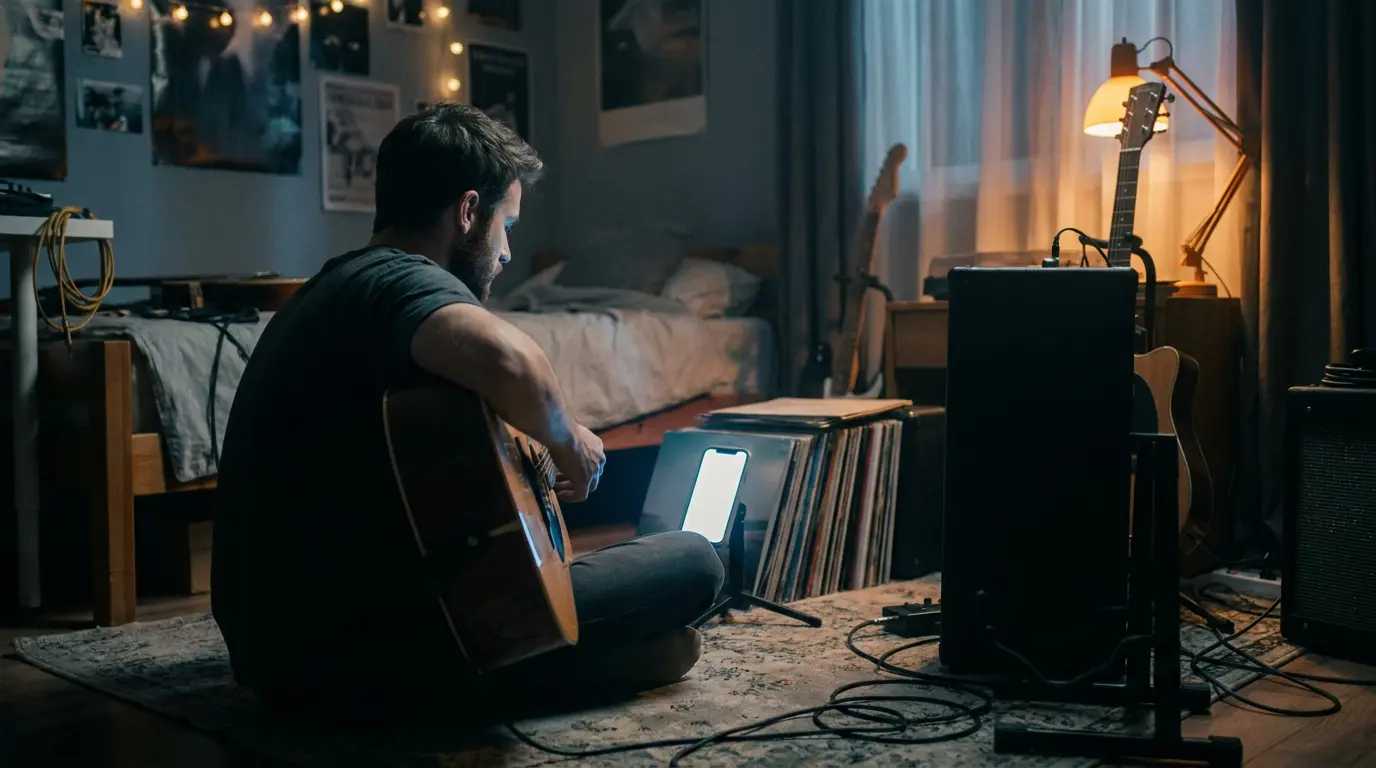
The phone in your pocket is a genuinely good tuner. GuitarTuna by Yousician is the default for good reason: fast, accurate, free, and it's grown a whole library of chords, tabs, and tutorials around the tuner. There's little wrong with it beyond the occasional upsell.
Plenty of other solid picks are out there too. Fender Tune and Tunable both give quick, reliable feedback. On Android, Pano Tuner or gStrings get the job done with almost nothing to learn. And if you want a no-frills chromatic tuner on iOS, Cleartune is a classic, with BOSS Tuner as a free option worth a look. For more options, MusicRadar keeps a good running list of the best guitar tuner apps.
The one honest limitation: apps listen through your phone's mic, so background noise hurts accuracy. In a quiet room they're great. In a loud rehearsal space, reach for the clip-on.
Method 3: Free online and browser tuners
If you're sitting at a computer with no tuner and no app handy, a browser-based tuner will save you. You open a webpage, give it access to your mic, and play — same idea as an app, just running in your browser.
These are handy in a pinch, especially when you're recording at your desk and realize you're out of tune. The same caveat applies: it's listening through a microphone, so keep the room quiet for a clean reading.
Method 4: Tuning by ear (the 5th-fret method)
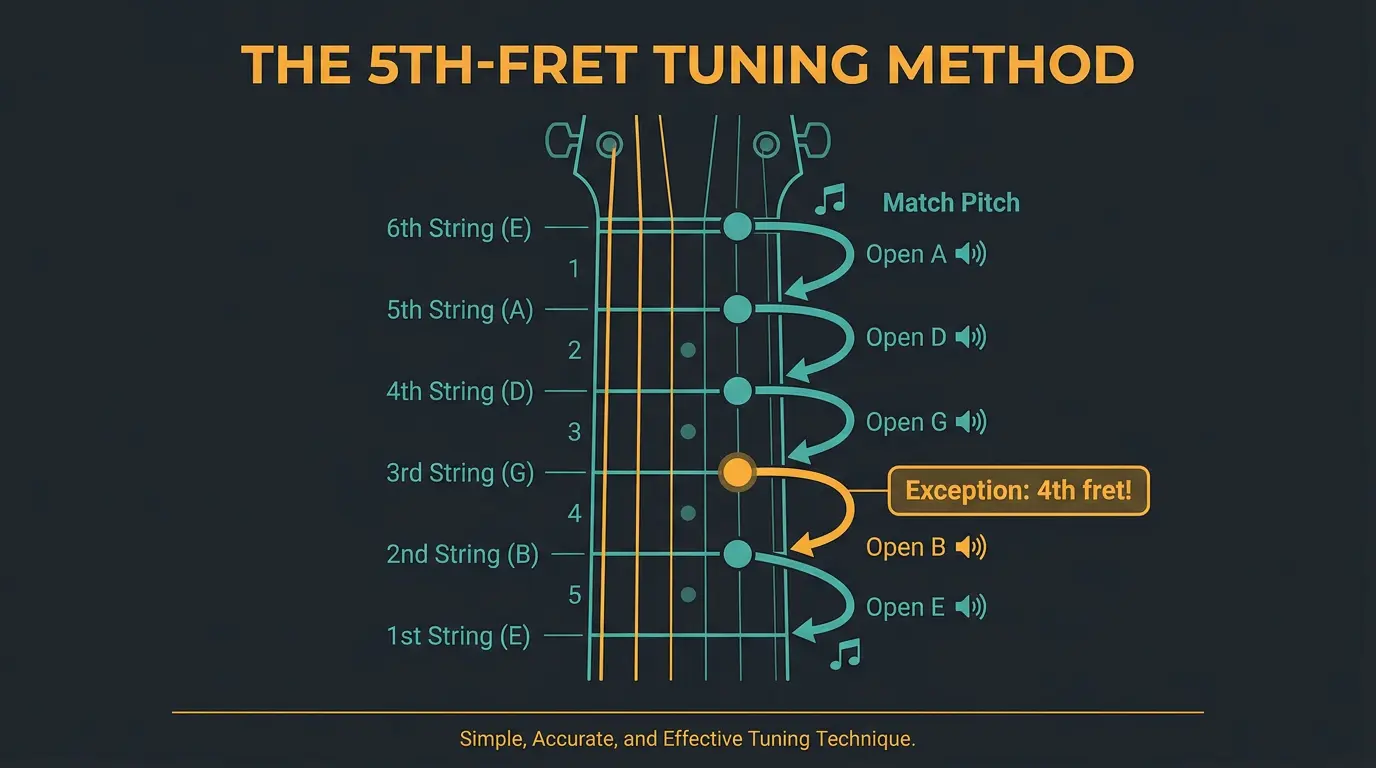
Tuning by ear is worth learning even if you own five tuners. It trains your ear and it saves you when the battery dies. The catch: you still need one reference pitch to start from, so get your low E in tune with something first, then tune the rest to it.
The 5th-fret method works down the neck like this:
- 5th fret of the 6th string (E) matches the open 5th string (A).
- 5th fret of the 5th string (A) matches the open 4th string (D).
- 5th fret of the 4th string (D) matches the open 3rd string (G).
- 4th fret of the 3rd string (G) matches the open 2nd string (B).
- 5th fret of the 2nd string (B) matches the open 1st string (E).
Notice that one exception: the G-to-B step uses the 4th fret, not the 5th. That's the mistake almost everyone makes the first few times, so burn it into memory. Once you're comfortable, look into tuning with harmonics — it's a more advanced approach that gives you tighter accuracy.
Reference pitch: what A440 means (and 432 Hz)
A440 is just the global standard for what "in tune" means. It sets the A above middle C at 440 cycles per second, and most orchestras, bands, and electronic instruments tune to it worldwide. When your tuner reads a note as correct, it's using A440 as the anchor.
Most tuners let you shift that reference in 1 Hz steps if you ever need to match a fixed instrument or a recording that isn't quite on pitch. You'll rarely touch it, but it's there.
You'll also run into people tuning to 432 Hz, chasing what they describe as a warmer or more "natural" sound. It's a niche preference, and that's fine. Just know the healing and spiritual claims that get attached to it aren't backed by science — if you like how it sounds, use it, but don't expect it to fix your life.
Beyond standard: a quick word on alternate tunings
Standard is where everyone starts, but it's not the only game. Drop and alternate tunings open up different chord shapes and sounds, and whole genres lean on them for their signature vibe.
The good news is a chromatic tuner handles all of it, since it reads every note rather than just the six in standard. So if you go hunting for a heavier drop tuning or something more open and droning, a chromatic clip-on or app has you covered. Once you're tuning fluently, our guide on how to read guitar tabs is a natural next step for learning new songs.
Frequently Asked Questions (FAQs)
How often should I tune my guitar?
Tune every time you pick up the guitar to play, and check it again after a while if you're in a long session. Strings drift with temperature, humidity, and just being played. It takes ten seconds with a tuner, so there's no reason to skip it.
Why does my guitar keep going out of tune?
Most often it's new strings that haven't fully stretched yet, which settle after a day or two of playing and stretching. Temperature swings, humidity changes, aggressive bending, and slipping tuning pegs also pull you out. If it's constant, check that your strings are wound and seated properly at the nut.
Is tuning by ear or with a tuner more accurate?
A good tuner is more consistently accurate than most people's ears, especially a strobe or chromatic model. That said, tuning by ear trains you to hear pitch and gets you out of trouble when no tuner is around. Learn both — use the tuner daily, keep the ear sharp.
Do I need a chromatic tuner for drop tunings?
Yes, a chromatic tuner is the easiest choice for drop and alternate tunings because it reads all twelve notes, not just the six in standard. Most clip-on tuners and apps are chromatic by default, so you're probably already covered. Just tune one string at a time for a clean reading.
What's the difference between 440 Hz and 432 Hz?
440 Hz is the global tuning standard used by nearly all orchestras and electronic instruments, while 432 Hz is a slightly lower reference some players prefer for a warmer feel. The "natural" or "healing" claims around 432 Hz aren't scientifically supported. If you like the sound, use it; otherwise, stick with 440.
Final Thoughts
Tuning really is one of the simplest skills in guitar, and it pays off every single time you play. Grab a clip-on for the noisy rooms, keep an app on your phone for everywhere else, and spend a little time learning the 5th-fret method so you're never stuck.
Less is more here. Get in tune, keep the exception on that G string in mind, and go play. That's the whole job.
Some of the links within this article are affiliate links. These links are from various companies such as Amazon. This means if you click on any of these links and purchase the item or service, I will receive an affiliate commission. This is at no cost to you and the money gets invested back into Audio Sorcerer LLC.