A music producer is the person who shapes a song from a rough idea into a finished record. Part creative, part technical, all responsibility. If the artist has a vision, the producer is the one who makes it real.
Here's the thing though — the job in 2026 looks pretty different than it did even a few years ago. Home studios got good. AI showed up. Streaming rewrote the money math. So let's skip the mystique and talk about what a producer actually does today.
TABLE OF CONTENTS
The short answer
A producer oversees the creative and technical sides of making a recording. They work with the artist and the engineers to get the song sounding its best and matching what the artist is going for.
The easy comparison is a film director. The director doesn't operate every camera or write every line, but they own the vision and steer everyone toward it. A producer does the same for a song.
With that being said, the role bends to the situation. A hip-hop producer building beats from scratch and a producer coaching a folk singer through a live take are doing very different jobs under the same title. The genre, the artist, and the project all decide what the day looks like.
What a producer actually does day to day
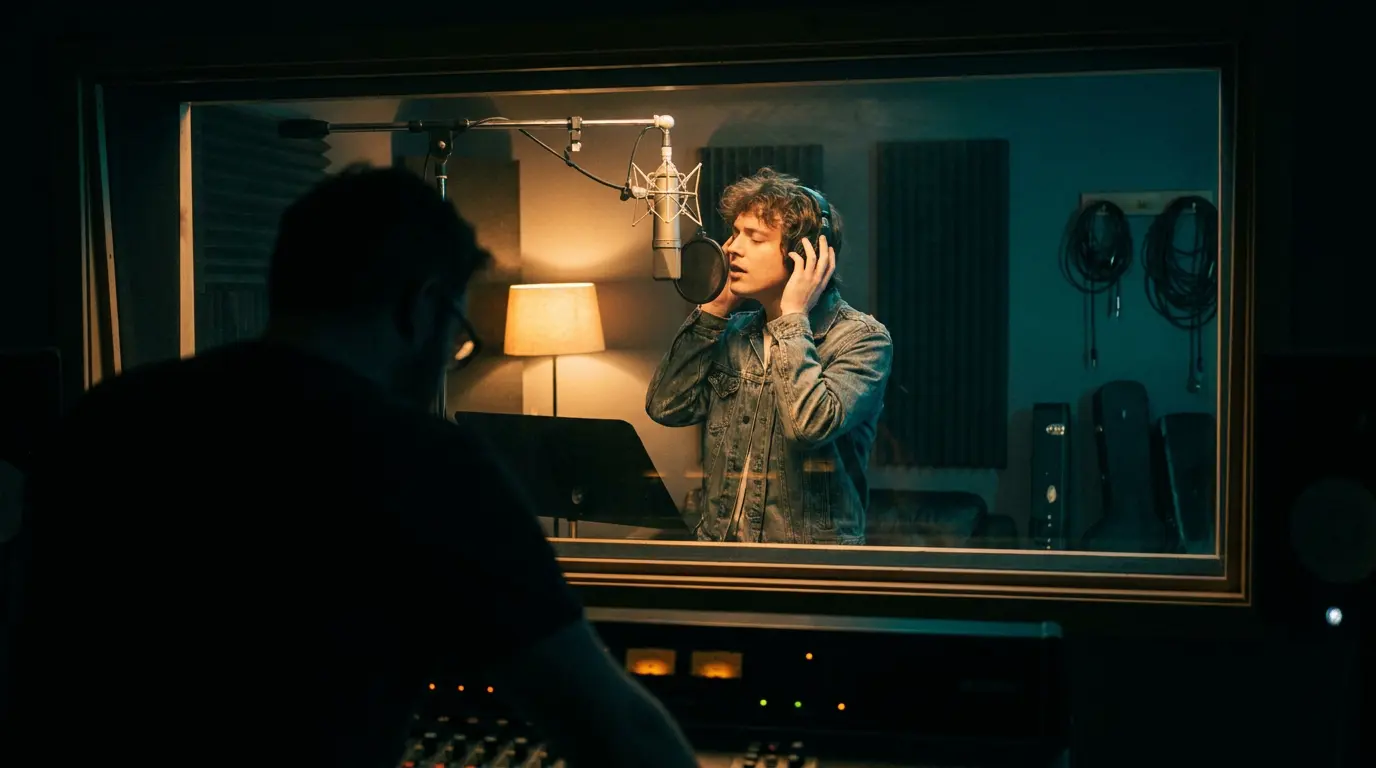
It starts before anyone hits record. In pre-production, the producer sits with the artist and figures out the vision — the mood, the themes, what the song is trying to say. That conversation sets the direction for everything after it.
Then comes the sound. Which instruments, which tones, which effects fit the feeling you're chasing. A producer is making these calls constantly, often about things the listener will never consciously notice but would absolutely miss if they were wrong. That work overlaps a lot with how you arrange a song — deciding what plays, when, and why.
There's also the unglamorous part: scheduling sessions, booking players, keeping the project on time and on budget. Studio time isn't free, and a producer who can't run a calendar loses money and trust fast.
But the piece people underrate most is the coaching. Getting a nervous vocalist to relax and actually deliver is as much the job as picking the right preamp. You're reading the room, knowing when to push and when to call it for the day. The best performance usually isn't the most technically perfect one — it's the one that feels alive, and pulling that out of someone is a real skill.
The producer's core jobs
- Creative direction — shaping the vision with the artist so the finished song says what it's meant to say.
- Sound selection — choosing the instruments, tones, and effects that match the mood.
- Scheduling and budgeting — booking sessions and players, keeping the project on time and on budget.
- Eliciting performances — coaching the artist and musicians to deliver takes that actually feel alive.
The bedroom producer is the norm now

Home recording tech got good enough that most working producers now go project to project, freelance, often from a laptop and a pair of monitors. The big room with the wall of gear isn't the default anymore — it's the exception.
The go-to example is Finneas, who built Billie Eilish's early Grammy-winning catalog out of a bedroom. Not a fluke, not a marketing story. Just proof that the craft matters more than the address.
And honestly, less is more here. A tight setup you know inside and out will beat a giant studio you're intimidated by every time. You don't need more gear to make better records — you need to get better at using what you've got.
Where AI fits into the job
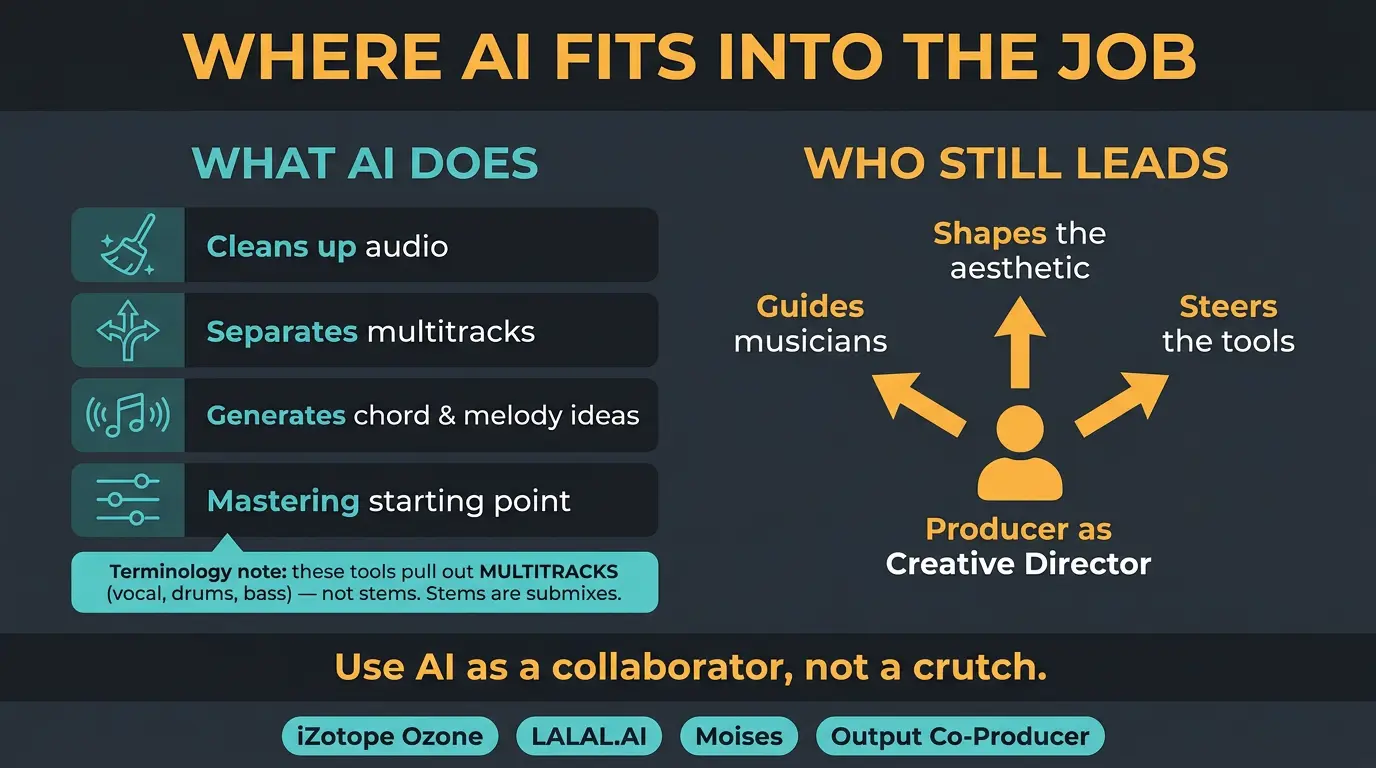
This is the biggest change to the role, so let's be straight about it. AI tools now clean up audio, separate multitracks out of a finished mix, generate chord and melody ideas, and hand you a solid mastering starting point. That's real, and it's mainstream in studios now.
Quick terminology note while we're here — a lot of these tools call it "stem separation," but what they're actually pulling out are individual multitracks: the vocal, the drums, the bass. Stems are submixes. It matters because being precise about it keeps everyone on the same page.
Here's the honest framing: AI hasn't replaced the producer, it's given the producer new tools to direct. Surveys back this up — most producers use AI as an ideation tool for melodies and chord progressions, and a smaller share actually fold it into the final track. The role is drifting toward creative director: you guide the musicians, you shape the aesthetic, and now you steer the tools too.
The best practice is simple. Use it as a collaborator, not a crutch. A few worth knowing: iZotope Ozone's Master Assistant for mastering starting points, LALAL.AI and Moises for separating multitracks, and Output Co-Producer for finding sounds. I dug into this more in where AI actually helps in music production and where it doesn't if you want the fuller picture.
What producers need to know about streaming and AI disclosure
The platforms are moving on this, so it's worth knowing. Spotify, Apple Music, and others now ask you to disclose AI involvement in a recording. This isn't a gotcha — it's just part of the paperwork now.
Some platforms go further. Deezer actively filters AI-generated tracks out of its recommendations and demonetizes the fraudulent ones to protect the royalty pool for human artists. And make sure you know about Spotify's threshold — since 2024, a track needs at least 1,000 streams over 12 months before it earns any royalties at all.
None of this is cause for alarm. It's just the modern workflow, and a producer who's aware of it saves their artists headaches down the line.
How music producers get paid
There's no single answer, which trips people up. Producers get paid through flat fees, hourly rates, advances, royalties, publishing shares, sync fees, salaries, or some combination of all of it. What you earn depends on your credits, your genre, your client base, and whether you own any rights in the music you help make.
The part worth understanding is producer points and recoupment. A point is a percentage of royalties — say a 3% producer point on a single. If you took an advance up front, that advance gets recouped first, meaning your royalty share pays it back before you see anything beyond it. Once it's recouped, the royalties become actual earnings.
On salary, be careful with any single number you see online. The aggregators disagree wildly — some put the U.S. average around $60,000, others report figures well over double that. The honest read is that entry-level work often lands in the tens of thousands, and experienced producers with a real track record can negotiate a lot higher. Treat any one source as a rough guide, not gospel. For a solid overview of the role and its economics, CSUN's Tseng College has a good breakdown of what a producer does in the music industry.
How to actually become one
There's no license and no single required degree. Artists, labels, and clients care about your portfolio — your credits, the quality of your sound, and whether you're reliable and easy to work with. That last one is bigger than people think. Talent gets you in the door; being someone people want to spend twelve hours in a room with keeps you there.
Music theory helps, but mostly as a communication tool. Knowing the names of things lets you talk to musicians quickly. It's not a gatekeeper.
So start where you are with what you have. Record a friend's song. Finish something badly, then finish the next one a little better. If you're still nailing down the fundamentals, working through how to make a song from start to finish is a good place to build reps. Trust your ears and put in the work — that's the whole game.
Frequently Asked Questions (FAQs)
What's the difference between a music producer and an audio engineer?
A producer owns the creative vision and decisions of a song, while an audio engineer handles the technical execution of capturing and shaping the sound. Think of the producer as the one steering the whole ship and the engineer as the one dialing in the mics, levels, and signal chain. On smaller projects, one person often does both.
Do you need a degree to be a music producer?
No, you don't need a degree or any license to be a music producer. Clients and labels care about your portfolio, your credits, and the quality of your work far more than a diploma. A degree can teach you faster and build connections, but plenty of working producers are self-taught.
Can you produce music from home?
Yes, you can absolutely produce professional music from home, and most working producers now do exactly that. Home recording tech got good enough that a laptop and a decent pair of monitors can make records that compete. Finneas built Billie Eilish's early catalog this way — the craft matters more than the room.
Do music producers use AI?
Yes, many producers now use AI tools for ideation, cleaning audio, separating multitracks, and generating mastering starting points. Most use it to spark ideas rather than to make final tracks. The healthy approach is treating AI as a collaborator you direct, not a crutch that replaces your own ears.
How do music producers make money?
Music producers make money through flat fees, hourly rates, advances, royalties, publishing shares, sync fees, and salaries — often a mix of several. A common structure is producer points, a percentage of royalties, sometimes paired with an advance that gets recouped first. Income varies hugely based on credits and client base.
Final Thoughts
So a producer is a creative director, a technical lead, a coach, and a project manager, usually all in the same afternoon. The tools have changed and the money math has shifted, but the core of it hasn't moved — you're the one responsible for turning an idea into a record that feels right.
If you're just getting started, don't wait for the perfect setup. Make something with what you have, trust your ears, and stack up the reps. That's how everyone who does this for a living got here.
Some of the links within this article are affiliate links. These links are from various companies such as Amazon. This means if you click on any of these links and purchase the item or service, I will receive an affiliate commission. This is at no cost to you and the money gets invested back into Audio Sorcerer LLC.