More than 90% of people report a song stuck in their head at least once a week. About 60% get one every single day. Scientists call it involuntary musical imagery, or INMI. You probably call it an earworm, and you probably know exactly what I mean.
Here's the thing most articles skip: they list a few tricks and move on. I want to get at the why. Why does a chorus loop in your brain while you're brushing your teeth, and what can you actually do with that as a songwriter? Let's get into it.
TABLE OF CONTENTS
What an earworm actually is
An earworm is a tune that spontaneously enters your head and repeats without you asking it to. The scientific name is involuntary musical imagery. The word "earworm" itself is a translation of the German ohrwurm, which has described this feeling for a long time.
Now here's a misconception worth clearing up. People assume earworms are mostly annoying. They're not. The ones we hate stand out because they bug us, but research suggests most earworms are actually a pleasant experience. That matters, because the goal here isn't to write something irritating. The goal is memorable.
Why choruses loop in your brain
Earworms seem to settle into a part of your brain called working memory. That's the same system you use to hold a phone number for a few seconds or do a bit of math in your head. When a tune parks itself there, it crowds other stuff out, which is why you can't focus while a hook is on repeat.
Two things drive it: familiarity and recency. You have to know a song well for your brain to replay it on its own. Something you barely know won't loop, because the brain doesn't have enough of it stored to spin up without effort.
They also tend to show up in low-attention moments. Walking, running, brushing your teeth, doing dishes. Anything with a little rhythm to it and not much for your mind to chew on. For more on how the brain latches onto music, this Harvard Gazette interview with a music cognition researcher is a good read.
The unfinished-song theory
There's a fun idea here called the Zeigarnik effect, named after psychologist Bluma Zeigarnik. The gist: your brain holds onto unfinished tasks more tightly than finished ones. Applied to music, a half-remembered tune stays "open," so it keeps coming back until you resolve it.
It's a compelling theory. I'll be honest, though — it's not settled science. A 2013 study found songs still playing at the end of a class showed up as earworms more often a day later, which lines up with the idea. But an experimental study by McCullough-Campbell and Margulis in 2015 found no difference between finished and incomplete songs. So take the unfinished-song story as an interesting maybe, not a fact.
Three things memorable choruses have in common
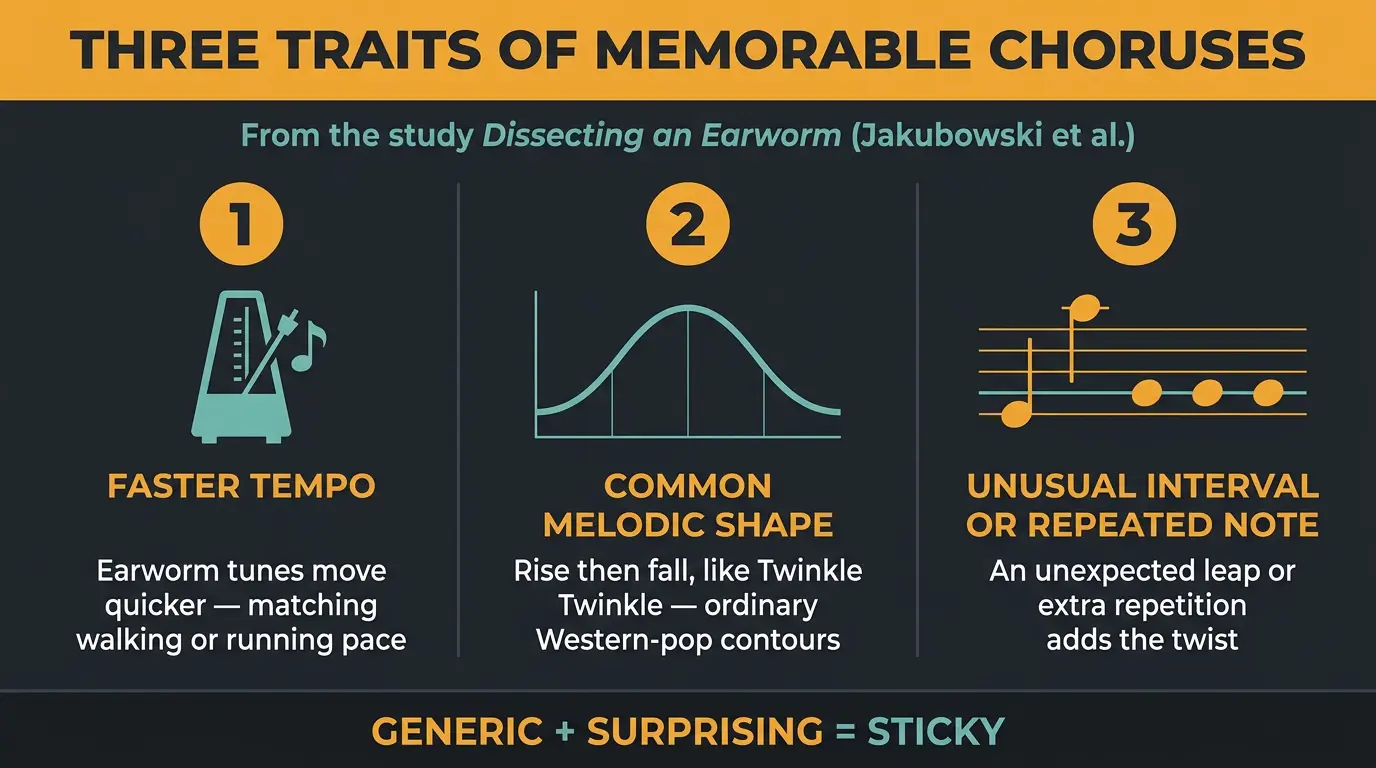
This is where craft comes in. Researchers Jakubowski and colleagues ran a study called "Dissecting an Earworm" — they took 100 tunes people frequently named as earworms and matched them against 100 tunes nobody named, controlling for popularity and style. Then they compared them across 83 melodic features. Three things stood out.
- Faster tempo. Earworm tunes tended to move quicker. That likely ties back to the movement thing — a lot of earworms surface while you're walking or running, so a tempo that keeps pace fits.
- A common melodic shape. The stickiest tunes used ordinary contours — shapes you hear all over Western pop. The classic is "Twinkle, Twinkle Little Star": the first phrase rises, the second falls. The opening riff of "Moves Like Jagger," one of the most-named earworms, does the same rise-then-fall.
- An unusual interval or a repeated note. This is the twist. On top of that familiar shape, there's an unexpected leap or more repetition than you'd expect. Think of the opening of "Smoke On The Water" or the chorus of "Bad Romance."
Notice that generic and surprising are both on the list. That's not a contradiction — it's the whole point.
The earworm sweet spot
- A shape people can predict — a common melodic contour they've heard a thousand times before.
- One detail they can't predict — an unexpected leap or a repeated note that snags the ear.
- A tempo that moves, so the tune fits the walking, running, everyday moments where earworms show up.
Repetition and singability
Our brains are pattern machines. Repeat something and you build a little neural loop that reinforces memory and familiarity. That's a big part of why choruses stick — they come back around, and every pass drives the tune a bit deeper.
Earworm songs are also easy to sing. The melodies people report tend to be simple and repetitious — mostly stepwise motion with the occasional simple leap, and longer notes sitting right on the hook. If someone can sing your chorus back after one listen, you're most of the way there.
So when people ask how to write a chorus that people remember, the plainest answer is this: make it easy to sing back. If it's a chore to sing, it won't loop. For more on building that central line, my breakdown of what a hook is in music goes deeper.
Prosody: making words and melody fit
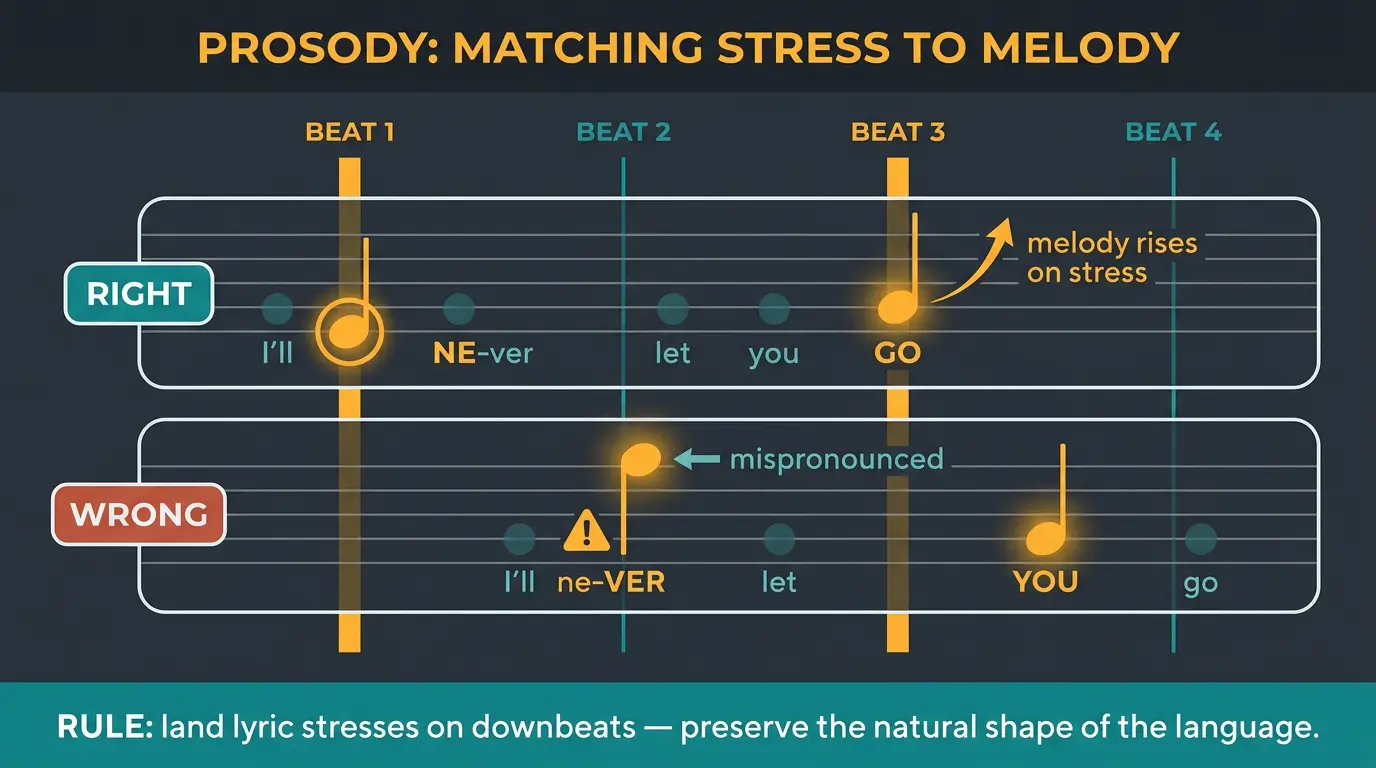
Here's the part that separates the choruses you can't shake from the ones you forget by lunch. It's called prosody — matching your lyric's stressed syllables to the melody's emphasis points, so words and music pull in the same direction.
The core rule is simple: land your lyric stresses on the downbeats. Pat Pattison, who teaches songwriting at Berklee, is blunt about this. He says songwriting has tools, not rules — with exactly one exception, and prosody is it. His mantra is "preserve the natural shape of the language."
Take the line "I'll never let you go." Say it out loud. The natural stresses fall on "nev" and "go." So put "nev" on a strong beat and let the melody rise on "go" for the emotional payoff. Now flip it — drop a long, high note on an unstressed syllable and the word gets effectively mispronounced. Speak the line in the melody's rhythm without any pitch and you'll hear the mismatch instantly.
Get this right and the chorus feels inevitable, like it couldn't have gone any other way. That's a huge chunk of memorability, and it pairs with everything in my guide to writing lyrics that actually connect.
Should you even try to write an earworm?
Here's a fair counterpoint I've heard from songwriting teachers: why would you aim to write something invasive and involuntary? Nobody signs up to annoy people. And honestly, that's the right instinct.
So reframe it. Don't chase "stuck in your head against your will." Chase memorable and welcome. Use repetition as an organizing feature. Build a hook that's fun and easy to sing back, and let it pull the whole song together.
One more honest note: it's not all in the melody. Popularity and exposure feed catchiness in a loop — catchy songs get more airtime, more airtime makes them feel catchier. You can write a perfect chorus and still need people to actually hear it a few times.
With that being said, there's no single right way to do any of this. Familiar shape, one surprise, words that sit naturally on the beat — that's a solid map. But trust your ears over any checklist. Less is more, and the ear knows when a chorus lands.
Frequently Asked Questions (FAQs)
What is an earworm?
An earworm is a tune that enters your head on its own and repeats without you trying to recall it. Scientists call it involuntary musical imagery, or INMI. The name comes from the German word ohrwurm. Most of them are actually pleasant, not annoying.
Why do choruses get stuck in your head?
Choruses get stuck because they settle into your working memory, and repetition builds a neural loop that keeps replaying. Familiarity and recency drive it — you have to know a tune well for it to return. They surface most during low-attention activities like walking or brushing your teeth.
What makes a chorus memorable?
A memorable chorus pairs a common, predictable melodic shape with one surprising detail — an unexpected leap or a repeated note. Research points to faster tempos, familiar contours, and unusual intervals. The sweet spot is conventional yet novel: a shape you can predict, punctuated by something you can't.
Does repetition make a song catchier?
Yes, repetition makes a song catchier because our brains are wired for patterns and repeated phrases build memory loops that reinforce familiarity. That's a big reason choruses stick more than verses. Just keep the repeated part easy to sing, or it won't take hold.
What is prosody in songwriting?
Prosody in songwriting is matching lyrics to melody so stressed syllables land on the melody's emphasis points, usually the downbeats. It makes words and music feel natural together. Get it wrong — a long note on an unstressed syllable — and the word sounds mispronounced. Berklee's Pat Pattison calls it the one real rule.
Final Thoughts
An earworm isn't magic. It's a familiar shape, one small surprise, and words that sit where they naturally want to sit — repeated enough times to stick. When you understand the why, you stop guessing and start writing choruses on purpose.
Make sure you sing your chorus out loud before you call it done. If it's easy to sing back and the stresses fall in the right places, you're onto something. The rest is craft, and craft is just the work.
Some of the links within this article are affiliate links. These links are from various companies such as Amazon. This means if you click on any of these links and purchase the item or service, I will receive an affiliate commission. This is at no cost to you and the money gets invested back into Audio Sorcerer LLC.